

Scorched Earth
How ISIS continues to use arson and crop destruction, and how it spread to Jordan

ISIS has revived an older tactic of burning crops of targeted enemies, showing that the livelihoods of those it deems enemies will be destroyed. In 2019, following heavy loss of territory, ISIS deployed a new tactic in Iraq and Syria, setting hundreds of hectares afire across the two countries' farming regions in what came to be known as Scorched Earth. This was in line with the group's new logic, which I have termed in previous writing as Disruption over Victory. The trend continued well into 2022.
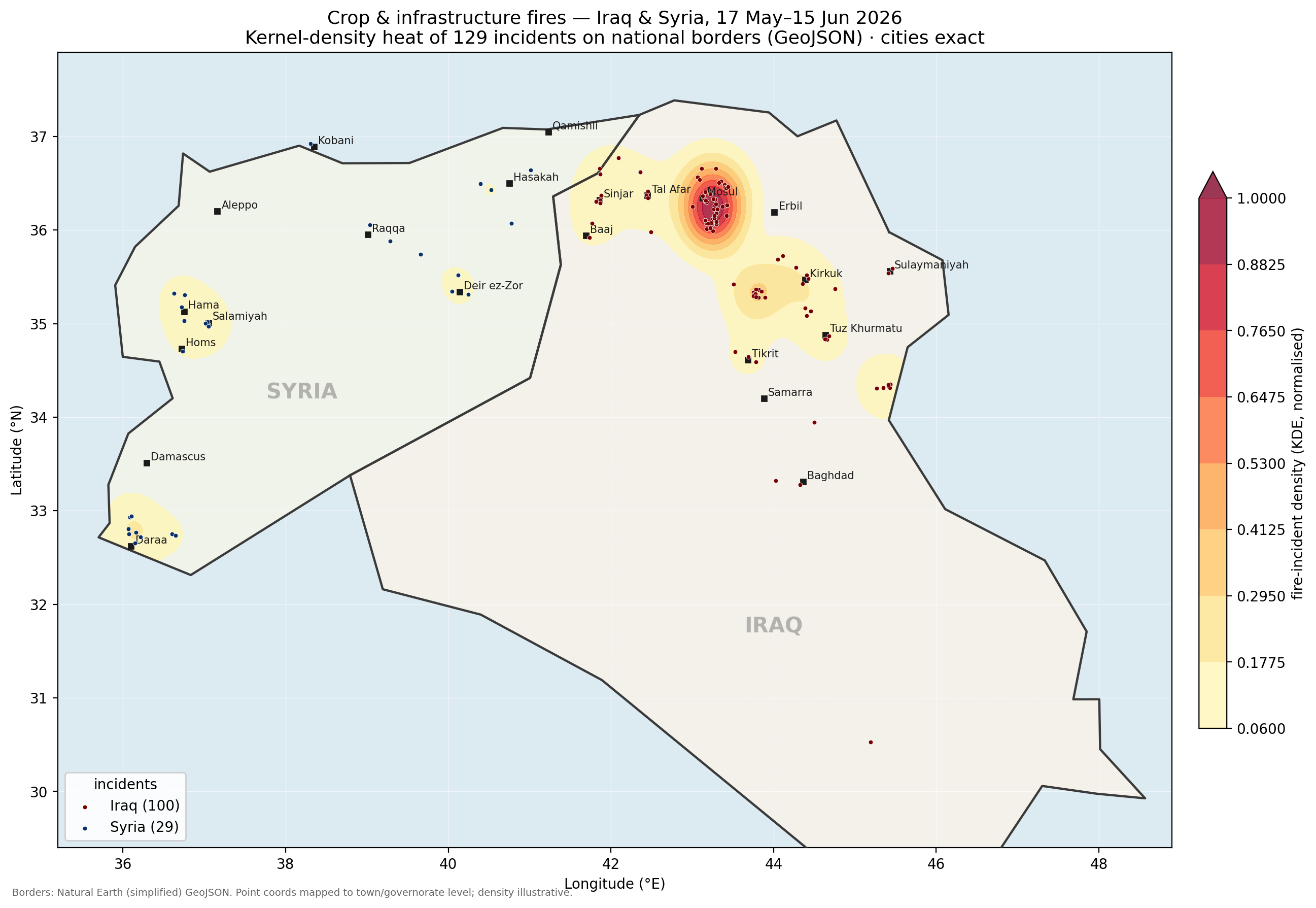
Six months ago, the trend came back. Across multiple ISIS channels on Telegram, incidents of crop arson started circulating: a fire near Bashiqa, a field near Hawija, and another near the Damascus-Daraa highway. I logged 129 incidents that appeared in ISIS channels between May 17 and June 15. I've mapped them, and the pattern went from the Nineveh Plain and around Kirkuk, then westward across the Syrian Jazira, Hasakah, Raqqa, and Deir ez-Zor, and eventually slid south toward Daraa. The largest fields were targeted in both countries during the harvest season to maximize damage.
Then, this month, a large fire swept through swaths of wheatland in Hawara, outside Ramtha, Jordan. This was not the first such fire in Jordan. For the last several weeks, fires have been destroying Jordan's wheat fields, with different fingers pointing the blame at different actors, none of whom are ISIS.
Three Things You Should Know:
1. Iraq: The fires in Iraq are not merely a disruption to the agricultural sector. They are a targeted attack on PMF property, revenue, local legitimacy, and power. The zones highlighted on my map, (the Nineveh Plain, Kirkuk, and Salah al-Din) are all heavily controlled by the Iraqi PMF.
The PMF has expanded into financial and agricultural institutions. Their commercial arm, Al-Muhandis Group, was given a $305 million US dollar injection from the state in 2023, is unaccountable to public audit, and has been handed land grants in different areas of Iraq. It has replicated the IRGC’s economic empire. The PMF has moved into afforestation schemes, farm-restoration projects, and the takeover of land across Iraq. An example is the Nineveh Plain. The Babylon Brigade (under the US-sanctioned Rayan al-Kildani) controls the belt from Tel Kayf through Batnaya to Bashiqa. The Badr Organization controls the Shabak villages. ISIS messaging on their channels specifically names which PMF militia owns which field that ISIS claims to have set on fire.
Aside from targeting PMF militias, ISIS is also targeting the state itself. Iraq is one of the most oil-dependent economies and crude amounts to almost 90% of the government’s revenue, almost half of its GDP, and over 90% of its exports. Agriculture has emerged as an option for the state’s diversification hopes, and the country’s wheat was a testament to Iraq’s capacity.
ISIS is actually launching a double strike. Iranian-backed militias are losing their local patronage systems, and Baghdad’s success story is taking a hit. It attacks the legitimacy of financing and arming the PMF, which claims to be needed as a protector of these areas, while being unable to protect its own wheat. And the state is seen as weak, unable to protect its own lands or the most fragile communities, who depend on the harvest season.
2. Syria:
The Jazira, meaning Hasakah, Raqqa, and Deir ez-Zor, is Syria’s breadbasket and its oil reservoir, making it the country’s economic lung. Until this year it was under the control of the Kurdish-led SDF and its autonomous administration. For the first time since the war began, the central government in Damascus controls the wheat.
That makes the harvest the new government’s top priority. Ahmad al-Sharaa’s administration now buys the crop through the state cereal authority: it set a purchase price of between $290 and $320 a tonne, and the president decreed an extra $130 incentive to pull farmers to deliver to government silos. When an earlier price cut triggered farmer protests, Sharaa personally reversed it. That is how politically charged bread is for a state only months old and still trying to establish control over a fragmented country. Feeding the country is the clearest test of whether Syria can actually govern the territory it has just reclaimed.
This season’s crop is projected near one million tonnes, by some counts only about 19% of what the country needs, under the worst drought in recent memory, with millions food insecure. ISIS is resurgent in these conditions. Add to that context, the Suwayda separatist movement and the Israeli occupation in the south. ISIS has carried out dozens of attacks across the northeast through 2025 and into 2026, concentrated in Deir ez-Zor, many of them by gunmen on motorbikes.
Monitoring a number of ISIS channels, and cross-referencing the ones focused on Iraq against those focused on Syria, it is clear that scorched earth was activated in Syria around the 30th of May. Peak harvest season. ISIS is adding fire to popular rage. Destabilizing the fragile Syrian state by making it fail to achieve the one thing it needs, ISIS destroys the livelihood of their targeted enemies but also punishes the people as a whole. Every torched harvest tells Syrians that Damascus claims to have the breadbasket but cannot protect it. The bread the government promised is going up in smoke in the very region it just absorbed.
3. Crisis on crisis
Since February 28, of this year the region has been engulfed in the war with Iran. I argued, when this began, that Iran’s war was on the globalized social contract. By attacking the Gulf and closing the Strait of Hormuz, the war shook the world’s economy and halted numerous air and sea routes. Gulf growth is declining from near 4% toward zero this year. The whole region’s GDP is now forecast to shrink by about 2.2% in 2026.
The shock does not stay in the Gulf. Food inflation spiked the moment the Strait shut (global food prices hit their highest since early 2024), and it fell hardest on the economies that import their food. The biggest growth declines in the region were in Iraq, Jordan, Lebanon, and Egypt.
Against this backdrop, ISIS’s scorched earth is making a comeback, opening a second front. Iran went after the region by targeting the oil-rich economies, while ISIS is going after food in fragile countries. In a normal year, Iraq’s strategic reserve can handle a bad fire season. In 2026, with a bottleneck in Hormuz and a drought forcing it back to importing 2.4 million tonnes of wheat, that shock absorber is thin. Syria has no shock absorber at all. ISIS is not strong, but it does not need to be. A burned field is a small input that produces an outsized effect because the system around it is already maxed out. While the new government is still struggling to assert control over the land, handle violent crimes, and is struggling with its own domestic legitimacy, it now has to deal with an economic sucker punch.
We should not read these as separate fires, in different countries. When you map them out, they are a war on the food supply that followed a war on a social contract, all of it happening when the states’ shock absorbers are at their weakest, or nonexistent.
My Take:
Now to Jordan. Since June 6, fires have been in Irbid, Al-Ghor, and Karak. In Karak the farmers are not waiting, they are bringing in extra harvesters trying to get the crop in before the next field goes up.
I have written before that Jordan does not live on its harvest. We import more than 95% of our wheat. What we grow covers about a week of what we eat. So no fire can starve this country. But wheat, for us, is a symbol of sovereignty. During this recent war, IRGC-linked hackers tried to increase the temperatures of wheat silos, to rot the national reserve quietly. They understood the target was not the grain. It was the symbolism. ISIS’s scorched earth is attempting the same.
Jordanian opposition says this either is an Israeli action to sabotage the country’s food or fragments of the Iranian missiles we intercepted falling back onto our fields (in a bizarre way, blaming ourselves for “standing on the wrong side of the war”). The first paints the state as victim, the second as collaborator. But these voices are downplaying the threat of ISIS to advance their own agendas.
If these fires are an ISIS operation and not just a dry year (with record rainfall), then the group is now running a coordinated campaign across three countries at once. This is disruption over victory in its purest form.
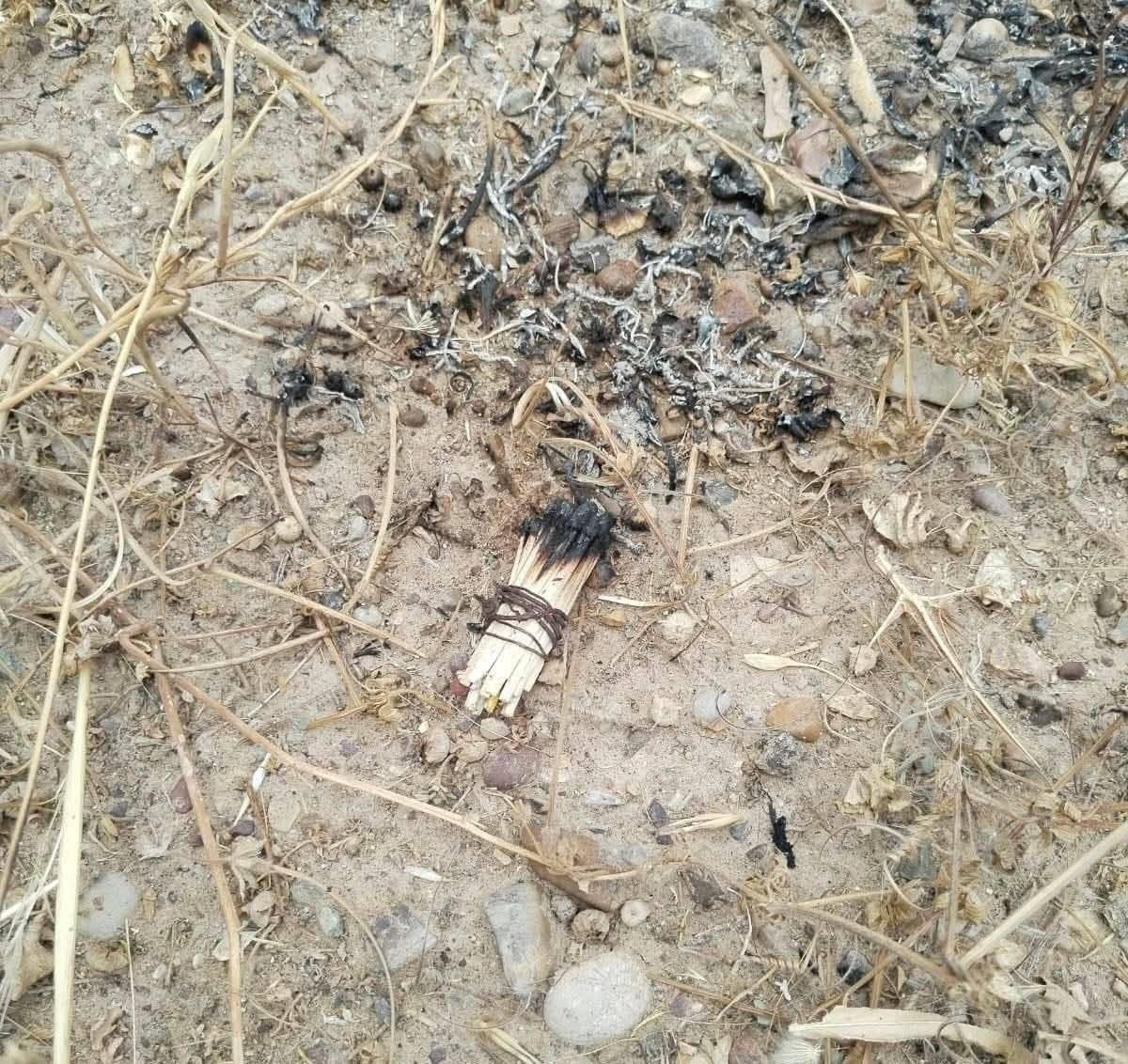
There is a popular opinion that ISIS is weakened and disappearing. Think tanks show the numbers of ISIS violent attacks and celebrate that the numbers are much lower than in previous years. If we look at the public violent attacks, that is true. But looking at their own communications, their own celebrations of fires, their own naming of the victims, and even photographic evidence, then these numbers (over a hundred in less than a month) show a very active ISIS in a destructive coordinated set of actions that can be easily carried out.
Fantastic reporting
Thank you Katerina for shedding light on this issue! Burning fields should amount to war crimes.